




The USA stock market today is being shaped by one big theme: doubts about how much companies are spending on artificial intelligence. On Thursday, October 22, 2026, the Nasdaq Composite fell 2.60% and the S&P 500 fell 1.21%, while the Dow Jones Industrial Average ended almost unchanged [1].
This page gives you the USA stock market today in one place: the latest closing numbers, a plain-English explanation of what moved prices, what is coming next and how to read any market report without panic. The snapshot is dated, so check the date before you rely on it, and use a live source if you need a price right now.
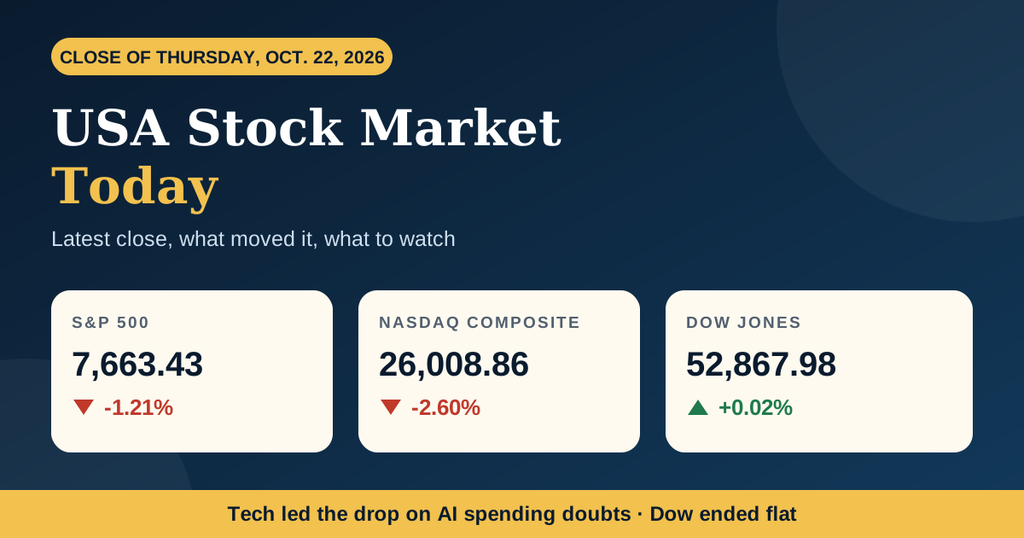
Table of Contents
- USA Stock Market Today: Snapshot of the Latest Close
- What Moved the Market on October 22
- Why the Dow Held Up While the Nasdaq Fell
- What Moves the USA Stock Market Every Day
- What to Watch Next
- How to Check the USA Stock Market Today
- US Stock Market Hours and 2026 Holidays
- What the Major Indexes Measure
- What to Do on a Red Day
- Mistakes to Avoid When Following the USA Stock Market Today
- Final Thoughts
- Frequently Asked Questions
- Sources
USA Stock Market Today: Snapshot of the Latest Close
Data as of the close on Thursday, October 22, 2026. Figures are from the Yahoo Finance market report on the close, and the index levels match Motley Fool’s page [1][2].
| Index | Close | Change (points) | Change (%) |
|---|---|---|---|
| S&P 500 | 7,663.43 | −93.74 | −1.21% |
| Nasdaq Composite | 26,008.86 | −694.00 | −2.60% |
| Dow Jones Industrial Average | 52,867.98 | +11.89 | +0.02% |
| Philadelphia SE Semiconductor Index | Not listed | Not listed | −6.7% |
Yahoo Finance described the Nasdaq’s drop as its steepest daily fall since early June. More stocks fell than rose on the Nasdaq, with 2,766 decliners against 2,022 advancers, and trading volume was 18.79 billion shares, above the 20-day average of 17.19 billion [1].

What Moved the Market on October 22
To understand the USA stock market today, start with the main driver: renewed worry about AI spending. Several big technology companies reported earnings, and investors focused on how much cash they are spending on AI rather than on the profits.
- Chipmakers sold off. Intel, AMD, Sandisk and Marvell each fell more than 8%, and the semiconductor index dropped 6.7% [1].
- Meta fell about 7% even though it beat expectations. Yahoo Finance reported its first cash outflow in over a decade because of AI spending [1].
- Tesla fell 3.1% despite unexpectedly positive free cash flow and lower planned capital spending for 2026 [1].
- Other AI names were under pressure. Motley Fool pointed to a warning from Lam Research about supply chain constraints and a downgrade of CoreWeave [2].
- Not everything fell. Spotify rose 11.1%, Blackstone 8.4%, Lockheed Martin 7.0% and Procter & Gamble 5.6% [1]. Consumer defensive and utilities stocks were the biggest sector gainers at midday [2].
- Oil rose on Middle East tensions, which adds to inflation worries [1][2].
One caution: all of this describes one day. A single selloff does not tell you where the market goes next, and the reasons given for a move are explanations after the fact, not predictions.
Why the Dow Held Up While the Nasdaq Fell
On days like this, the headline numbers can look contradictory. The Dow was flat, but the Nasdaq dropped more than 2.5%. The reason is what each index holds. The Dow tracks 30 large companies and weights them by share price. The Nasdaq Composite covers thousands of stocks weighted by company size, so a handful of large technology companies can move it a lot.
When technology falls and other areas rise, the Dow can hold steady while the Nasdaq drops. On October 22, Motley Fool’s midday report listed consumer defensive and utilities stocks as the top sector gainers [2]. The S&P 500 sits in between, because it holds 500 companies and technology makes up a large share of its value.
What Moves the USA Stock Market Every Day
Prices move because millions of buyers and sellers keep updating their view of what companies are worth. A few forces show up again and again:
- Company earnings. A stock moves on how results compare with what investors expected, not only on whether profits are up. That is why a company can beat estimates and still fall, as Meta did on October 22 [1].
- Interest rates and the Fed. Higher rates make borrowing more costly and can make future profits look less valuable, which often pressures stocks, especially growth companies.
- Inflation data. Hot inflation readings can push investors to expect higher rates for longer.
- Economic reports. Jobs, spending and manufacturing data change expectations for company profits.
- Global events. Wars, oil prices and trade news can shift risk appetite quickly.
- Investor mood. Fear and enthusiasm can push prices beyond what fundamentals alone would suggest, in both directions.
These forces interact, so a single cause is rarely the whole story. Reports usually name the biggest headline, and the real picture is often a mix.
What to Watch Next
- Earnings season. Yahoo Finance noted that 111 S&P 500 companies had reported so far and 83% beat estimates, so results are strong but investors are focused on spending and guidance [1].
- The Federal Reserve. The Fed’s next meeting is listed for October 27 and 28, with the decision on October 28 at 2:00 p.m. Eastern [4]. Yahoo Finance reported that markets were pricing in a quarter-point rate increase before year-end [1]. Check the Fed’s own site for the schedule and any statement.
- Inflation. Consumer prices rose 3.7% over the 12 months to September 2026, according to the Bureau of Labor Statistics [5]. Higher inflation can keep interest rates high, which tends to weigh on stocks.
- Jobs data. Motley Fool noted that weekly jobless claims fell to a three-month low [2].
- Oil and geopolitics. Higher crude prices can feed into inflation.
Because many of these items can change quickly, treat the list as a guide to what to read about, not a forecast of what will happen. Use it to follow the USA stock market today over the coming week.
How to Check the USA Stock Market Today
- Check the three main indexes. The S&P 500 shows the broad market, the Nasdaq shows technology and growth, and the Dow shows a group of large established companies.
- Look at the percent change, not only the points. A move of 100 points means very different things for the Dow (around 52,000) and the S&P 500 (around 7,600).
- Read the reason. A move on earnings, inflation data or Fed news means something different from a move on a quiet day.
- Compare with futures before the open. Futures show where the market may open, but they can change before trading starts.
- Use a live source for prices. This page is a dated snapshot. Your brokerage app, an exchange site or a major financial news site shows live quotes.
US Stock Market Hours and 2026 Holidays
The USA stock market today follows the same schedule as any other trading day: the NYSE and Nasdaq normally trade from 9:30 a.m. to 4:00 p.m. Eastern, Monday through Friday [3]. Extended-hours trading exists before and after those times, but availability and times depend on your broker.
The remaining 2026 closures and early closes are [3]:
| Date | Market status |
|---|---|
| Thursday, November 26 (Thanksgiving) | Closed |
| Friday, November 27 | Early close at 1:00 p.m. Eastern |
| Thursday, December 24 (Christmas Eve) | Early close at 1:00 p.m. Eastern |
| Friday, December 25 (Christmas Day) | Closed |
Veterans Day on November 11 is not a stock market holiday in 2026, though banks and bond markets are typically closed [3].
What the Major Indexes Measure
- S&P 500: 500 large US companies, weighted by company size. It is the most common measure of the US stock market as a whole.
- Dow Jones Industrial Average: 30 large companies, weighted by share price.
- Nasdaq Composite: thousands of stocks listed on the Nasdaq, with a heavy weight in technology.
- Russell 2000: a gauge of smaller US companies.
Most beginners do not buy these indexes directly. They buy funds that track them. If you are new to this, our beginner’s guide to investing explains stocks, index funds and risk in plain English.
What to Do on a Red Day
When the USA stock market today is in the red, a drop like October 22 can feel alarming, but for most long-term investors the best response is usually to stick to a plan you made when markets were calm. A few practical points:
- Check your time horizon. Money you need within a few years should not be fully in stocks. Money for retirement decades away has time to recover from drops.
- Do not act on one headline. Selling after a big drop locks in the loss, and no one can reliably predict which days will rebound.
- Keep a cash cushion. An emergency fund means you will not have to sell investments to pay a bill. See our guide on how to start an emergency fund.
- Look at the long run. You can test how steady contributions might grow with our free investment calculator.
This is general education, not personal advice. If you are unsure what to do with your own money, consider speaking to a licensed financial professional.
Mistakes to Avoid When Following the USA Stock Market Today
- Checking prices all day. Constant checking increases stress and makes impulsive trades more likely.
- Judging the whole market by the Dow alone. As October 22 showed, one index can hide a big move in another.
- Treating explanations as predictions. A headline that explains why stocks fell does not tell you what happens tomorrow.
- Trading on tips. Social media and live blogs move fast and are often wrong or incomplete.
- Ignoring dates. Always check when a market figure was published. Stale numbers are common.
Final Thoughts
The USA stock market today is a story of tech weakness on AI spending worries, a flat Dow and investors watching the Federal Reserve and inflation. That is useful context, but it is only one day. Use daily reports to understand what is happening, and use your own plan to decide what to do about it.
Bookmark this page for the latest dated snapshot, and confirm live prices with your broker before you place any trade.
Frequently Asked Questions
Why is the USA stock market down today?
On October 22, 2026, technology stocks led the decline as AI spending concerns resurfaced after big earnings reports. Chipmakers fell sharply and Meta dropped about 7% [1]. Check the date above, since the reasons change from day to day.
What time does the US stock market open and close?
The NYSE and Nasdaq are open from 9:30 a.m. to 4:00 p.m. Eastern, Monday through Friday, except on market holidays [3].
Is the stock market open today?
It is open on regular weekdays during trading hours. In the rest of 2026 it is closed on November 26 and December 25, with early closes on November 27 and December 24 [3].
What is the difference between the Dow, S&P 500 and Nasdaq?
The Dow holds 30 large companies weighted by share price. The S&P 500 holds 500 large companies weighted by size. The Nasdaq Composite covers thousands of Nasdaq-listed stocks and leans toward technology.
When is the next Fed meeting?
The October 2026 meeting is listed for October 27 and 28, with the decision on October 28 at 2:00 p.m. Eastern [4]. Confirm the date on the Federal Reserve’s website.
Why do stocks sometimes fall after good earnings?
Stocks move on results compared with expectations, and on what the company says about the future. On October 22, Meta fell about 7% even though it beat expectations, because investors focused on its heavy AI spending [1].
Where can I see live stock market quotes?
Use your brokerage app, an exchange website or a major financial news site. This page shows a dated snapshot, not live prices.
Sources
- Yahoo Finance: S&P 500, Nasdaq end sharply lower as revived AI doubts ignite tech selloff (Oct. 22, 2026).
- Motley Fool: Stock Market Midday, Oct. 22 (Oct. 22, 2026).
- Fidelity: Stock market holidays and trading hours.
- FedRateCalc: FOMC Meeting Schedule, October 2026. Confirm on the Federal Reserve’s website.
- U.S. Bureau of Labor Statistics: Consumer Price Index news release (September 2026 data, published Oct. 14, 2026).
This page is general information, not investment, tax or legal advice. Market data is a snapshot as of the date shown and may be revised. It is not a recommendation to buy or sell any security, and investing involves risk, including the loss of money.
#StockMarket #StockMarketToday #SP500 #Nasdaq #DowJones #Investing #WallStreet #MarketNews