Physical AI in Warehouses: How Robots Are Changing Work
Physical AI is moving robots from single tasks to coordinated fleets. Here’s how it works, a real example, and what it means for warehouse jobs.
Complete Blog Article
Table of Contents
- What Is Physical AI
- From Single Robots to Coordinated Fleets
- Real-World Example
- Why This Matters Beyond Warehouses
- Pros and Cons
- What It Means for Workers
- FAQs
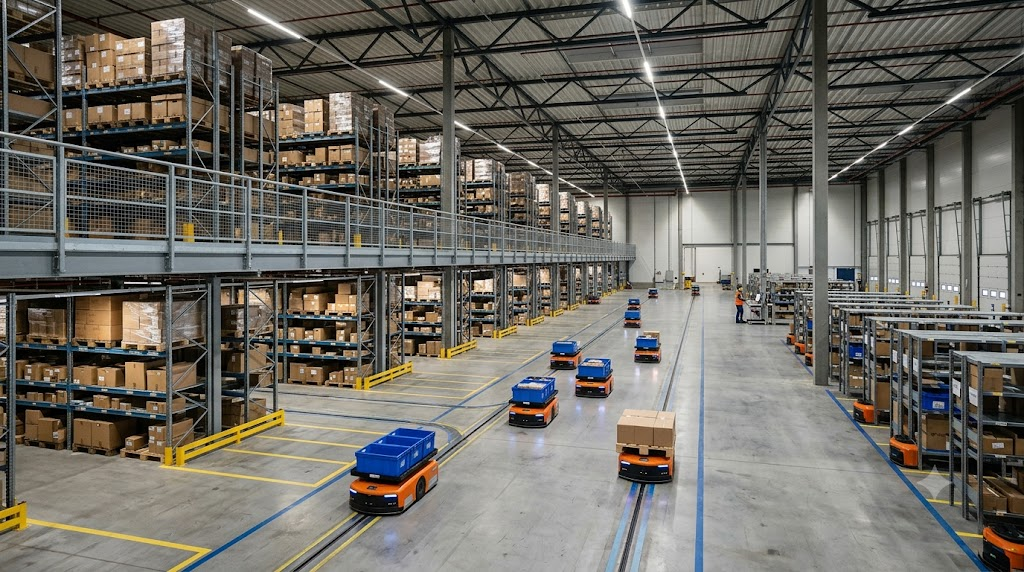
For years, warehouse robots did one job each — move a shelf, scan a barcode, lift a box. Physical AI changes that by letting a single system coordinate an entire fleet of robots at once, adjusting routes and priorities in real time.
What Is Physical AI
Physical AI refers to AI systems that operate in the real world through robots, drones, or other machines, rather than staying inside a chat window or app. Instead of just answering questions, physical AI senses its surroundings, makes decisions, and controls physical movement.
In a warehouse, this looks like a central AI system that tracks every robot’s location, battery level, and current task, then reroutes them on the fly to avoid delays — similar to how air traffic control manages planes, but for robots on a warehouse floor.
From Single Robots to Coordinated Fleets
Older warehouse automation worked robot by robot. Each one followed a fixed path or simple rule set. If a path got blocked, the robot would often just stop and wait.
Fleet coordination systems solve this differently. The AI has visibility into the entire warehouse at once, so it can:
- Reroute a robot around a blocked aisle before it even gets there
- Balance workload across robots instead of overloading a few
- Predict which robots need charging soon and schedule it without stopping operations
- Prioritize urgent orders dynamically as new ones come in
This is the difference between automation (following fixed rules) and physical AI (adjusting decisions based on real-time conditions).
Real-World Example
Business Example: Amazon’s robot fleet, which recently crossed one million active units, now runs on a coordination system called DeepFleet. According to the company, this system improved travel efficiency across its warehouse robots by about 10% by optimizing how robots move relative to each other, rather than each one just following its own shortest path.
That 10% might sound modest, but at the scale of a global warehouse network, it translates into meaningfully faster order fulfillment and lower operating costs — without adding a single new robot.
Why This Matters Beyond Warehouses
The same fleet-coordination approach is starting to show up outside logistics:
- Manufacturing: Car factories now have vehicles that drive themselves through long production routes, coordinated the same way warehouse robots are.
- Agriculture: Coordinated drone and ground-robot systems monitor and treat large fields more efficiently than single-machine operations.
- Delivery: Some companies are testing coordinated ground-robot fleets for last-mile delivery in dense urban areas.
The core idea is the same everywhere: intelligence isn’t limited to a single machine anymore — it coordinates many machines toward one shared goal.
Pros and Cons
| Aspect | Pros | Cons |
|---|---|---|
| Efficiency | Reduces wasted robot movement and idle time | Requires significant upfront infrastructure investment |
| Scalability | Coordination improves as more robots are added | Complex to design and maintain at scale |
| Worker safety | Reduces manual heavy lifting and repetitive strain | Requires new safety protocols around human-robot interaction |
| Job impact | Creates new technical and oversight roles | Reduces demand for some manual, repetitive roles |
| Reliability | Systems can reroute around failures automatically | A central system failure can affect the entire fleet |
What It Means for Workers
Physical AI doesn’t remove people from warehouses — it changes what people do there. Roles are shifting toward:
- Fleet monitoring and oversight — watching dashboards, handling exceptions the AI flags
- Maintenance and troubleshooting — physically fixing robots and sensors
- Process design — deciding how robots and humans divide tasks on the floor
Note: Analysts remain divided on the pace of this shift. Some warehouse operators report needing fewer manual pickers as fleets scale, while others report shifting existing staff into oversight and maintenance roles rather than reducing headcount. Both patterns show up depending on company size and how automation is rolled out.
Key Takeaways
- Physical AI coordinates entire robot fleets in real time, not just single machines.
- Amazon’s DeepFleet system improved robot travel efficiency by about 10% at scale.
- The same coordination approach is expanding into manufacturing, agriculture, and delivery.
- Worker roles are shifting toward oversight and maintenance rather than disappearing outright.
FAQ Section
1. What is physical AI? It’s AI that operates in the real world through robots or machines, sensing surroundings and making real-time decisions about physical movement.
2. How is physical AI different from regular warehouse automation? Older automation follows fixed rules per robot. Physical AI coordinates many robots at once, adjusting routes and priorities based on real-time conditions.
3. Will physical AI replace warehouse workers? It’s changing roles more than eliminating them outright — shifting people toward oversight, maintenance, and process design rather than manual tasks.
4. What companies are using physical AI in warehouses today? Amazon is a well-documented example with its DeepFleet coordination system managing over a million robots.
5. Is physical AI only used in warehouses? No — similar coordination approaches are expanding into manufacturing, agriculture, and delivery.
6. How much efficiency gain does fleet coordination actually provide? Amazon reported roughly a 10% improvement in robot travel efficiency after deploying its coordination system, though results vary by operation size and layout.
Conclusion
Physical AI marks a shift from robots that follow fixed instructions to systems that coordinate entire fleets in real time. The efficiency gains are measurable, and the approach is already spreading beyond warehouses into manufacturing and agriculture.
Key takeaway: The real advantage isn’t smarter individual robots — it’s smarter coordination between many of them.